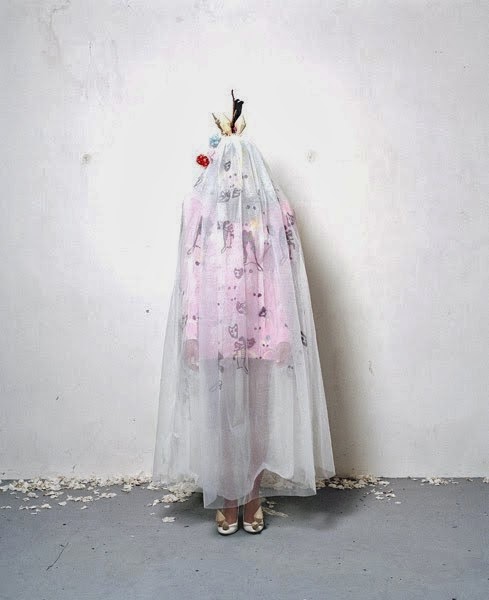
'Soul Scream' by Japanese designer Ryota Yamazaki a tribal punk mash of fabrics, colour and symbolism.


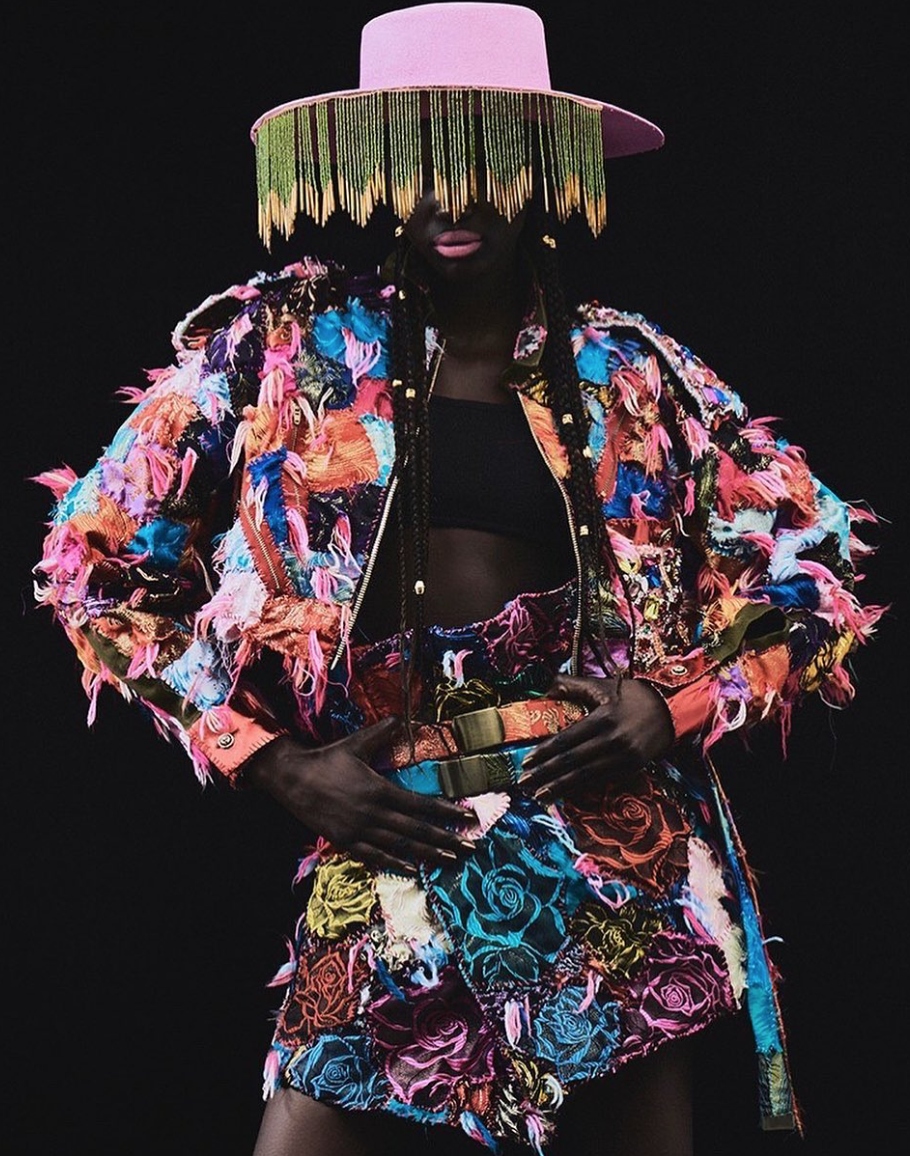

This collection goes so far as to be almost anti-erotic, in protest against the ‘sex sells’ ethic endemic in advertising and in the fashion industry. An attraction to vulgarity led me to my two main muses for this collection: Richard E. Grant’s character ‘Withnail’ in the film Withnail and I, and Rik Mayall’s character ‘Richie’ in the TV series Bottom. The behaviour of these two anarchic characters is wildly entertaining and curiously liberating for the viewer, but most importantly, they behave with shameless authenticity. Both Withnail and Richie reject society’s expectations of a ‘young gentleman’s’ behaviour and instead act with a complete lack of integrity. This has inspired the nonchalant aesthetic of my six looks. Drawing inspiration from archetypal feminine silhouettes, once favoured by rock legends Rod Stewart, Brian Jones and Mick Jagger in the 1970s, the purpose of this collection is to challenge our notions of beauty, masculinity and ‘manliness’, in the hopes of transforming our expectations of gender and sex roles for a more inclusive society. After all, as British milliner Stephen Jones says: “The vulgar is tremendous fun”. Clancy Dawson


"My work is all about sustainability; everything I’ve made is from waste. I contacted loads of fashion industry companies and asked them to give me their offcuts or damaged fabrics. I’ve put them through a process to pleat them, essentially making a new fabric. I wanted to revitalise waste and show that you can make beautiful things from other people’s rubbish. Craft is a big part of my work and I used a lot of hand processes which take hours to do. The idea is that I want people to treasure fashion rather than it be something disposable.

"I’ve got six different garments under the same theme but they’re all different fabrics. This coat, for example, is made from salvaged material which companies cut off at the edges after it’s been marked by the machinery. I’ve also got garments made from plastic waste, netting and all sorts of different materials brought together. I’ve always been interested in sustainability but this project was my chance to make everything I did as sustainable as possible. I had to think about everything down to the organic threads. It’s been a real challenge but I’ve learned so many zero-waste techniques for making by doing it." Fiona Cartmel


"My garment emerged from the Diversity Network project that The Edinburgh College of Art initiates every year in collaboration with "All walks beyond the catwalk". The purpose was to consider my practice as a designer applying my designs across a range of silhouettes / people/ morphology."Aurélie chose to tackle, within a panel of diverse people, the theme of masculinity in fashion, which she perceived to be pulled to two extremes; either very feminine (transgender wave) or very masculine (stereotypes conveyed through media) .
"I was really interested in Sam, he is an art student who equally dresses with womenswear and menswear. I researched gender in fashion and media and specifically gender fluidity."Aurélie through research came up with the concept of Sam not having to have the dilemma of choosing between masculinity and femininity but being able to accommodate both in one garment. A garment that celebrated a more sensitive masculinity and that is able to empower men who feel their body or personality
"As part of this project I had to include a 3D typography on the garment as a statement to reinforce my concept - the word Alpha is suggesting another word -"male"- to convey a strong contrast that is stated as an ironical criticism of society's expectations about masculinity." Aurélie Fontan


“Some of the larger pieces are made from around 400 individual pieces, it means that you can build your own piece of clothing and continuously reinvent your wardrobe without having to buy new clothes all the time. It is particularly good for children as it gives them control over their outfits and also helps to teach them about sustainability. In the fashion industry, people are always trying to produce things as fast as they can in large quantities and for low cost. I just feel that it is wrong – it encourages people towards over consumption and creates a lot of waste.” Karen Korjus


Tailoring is rational, succinct and considered. a craft controlled by the dimensions and form of the body it clothes. Drape is spontaneous, ruled by instinct and movement. it encompasses the body it possesses amongst swathes and folds, distorting it.Two conflicting aesthetics, mutual only in their clothing of the form are harmonised in the riding habit apron skirt; tailored when the wearer is mounted and a contorted, draped mass of fabric when she is not. Abigail Jubb’s re-contextualization of this complex garment produces a contemporary hybrid of tailoring and its antithesis, drape; asserting their conflict as a conceptual catalyst.a project informed by cultural citations of tailoring and drape alongside exploration of their social and visual narratives, the tensions between the two aesthetics are exploited by Abigail Jubb to formulate the design dialogue presented by Tailoring Versus Drape. Abigail Jubb


"Throughout my childhood and adolescence I was often surrounded by my fathers industrial and DIY materials. These materials were extremely inspiring and they still evoke in me an emotional and sentimental bond with my family and roots as a designer, nostalgic feelings that are so powerful that I knew they would keep me more excited than if I were to use traditional fashion fabrics. The use of those unconventional fabrics invites the viewer and myself to rethink functionality and innovation within fashion." Luis Miguel Sanchez Garzas