Showing posts with label ECA Fashion Show 2015. Show all posts

Wednesday, 10 June 2015

Imogen Woolley II


Imogen Woolley's interpretations of The Snow Child by Eowyn Ivey .
"As part of my Final Year Collection I designed costumes for Eowyn Ivey's 'The Snow Child'. With beautifully crafted descriptions and imagery throughout, Ivey creates an almost supernatural landscape, which is both beautiful and curiously terrifying at the same time.  We see Alaska for what it is, but are taken on a journey that seems to be always questioning what is really happening.  The descriptions are whimsical and enchanting yet are completely pure, and depict the scenery magnificently. I really wanted my costumes to have a cold and wintery feel to them, looking at fashion and textile designers that have worked with layered items of clothing. I have particularly focused on japanese and scandinavian fashion for my shape inspiration as there is a sense of purity and simple shapes that i really liked about these, taking interesting textiles and working them onto simple garment shapes. For my colour pallet I have mainly taken inspiration from Alaskan Architecture, whereby I found in the small towns many of the buildings were beautiful muted primary tones. I then wanted to link this to neutral colours, giving quite a naive but depth to the costumes" Imogen Woolley

Tuesday, 2 June 2015

Molly MacDonell Finlayson II


"When I first read The Ice Palace, it immediately took shape in my head as a contemporary ballet. With its sparse lyrical prose, strikingly visual language and perceptiveness about human relationships, it is rich material for translation into dance. Vesaas wrote extensively about the reader’s experience of transforming written words into visual images and emotional experiences. His writing is extraordinary: economical, simple, but reverberating with reference to sound, light, movement, colour, texture. I wanted to reflect the way Vesaas writes in my approach to designing the project. Vesaas uses extensive reference to the natural word to describe the emotional experiences of his characters. Many of his descriptions of rural Norway, I identified with my own childhood in rural Scotland. Making mono-prints, using twigs and plants from my home, I developed these into bold prints. Reaching across the costumes, they reflect the way that the human and natural worlds are so closely intertwined in The Ice Palace. Using these patterns, I created dyed, knitted and printed textiles, experimenting with a wide range of techniques. I was also heavily inspired by vintage ski wear, traditional Norwegian dress and both traditional Scandinavian and contemporary knitwear." Molly McDonell Finlayson

'Winter is approaching in a small, rural Norwegian community. A waterfall is gradually freezing into a vast ice structure: The Ice Palace. Two eleven year old girls make friends: reclusive Unn, and lively Siss, the headstrong and energetic leader of the children at school. The following day, Unn disappears. As the winter deepens and the search for Unn fails, The ice palace becomes the compelling focus for Siss’s struggle with grief and guilt. Siss takes on Unn’s role as an outsider, alienating herself from the children at school. Only as the spring thaw finally begins, and a series of important encounters occur, can Siss accept the knowledge that Unn is dead.'
The Ice Palace (Is-slottet) by Norwegian writer Tarjei Vesaas. 1963

You can catch all of the performance costume students work that I have been featuring on this blog this week at ECA until Sunday 7th of June.

Thursday, 28 May 2015

Molly MacDonell Finlayson I

"Inspired by Valentine’s Scots adaptation, I have re-imagined The Soldier's Tale as a small Scottish touring piece, making its way around far-flung village halls and community centres. Small-scale touring theatre is a lively and longstanding culture in Scotland, a world in which I have been involved since childhood. Touring theatre takes extraordinary, beautiful things to unexpected places."
"In my designs, I have taken inspiration from the colourful score and characterful language, and from Scottish landscape and culture.  Exploring the idea of journeying, I have created screenprinted textiles inspired by old maps of Scotland. Eccentric ensembles suggest dressing-up. Hand-painted tartans and screen-printed  textiles suggest that the actors have modified garments themselves, inspired by the landscape through which they are travelling. Connecting all these influences – music, language, landscape, dressing up – is the layering of colour and pattern."  Molly MacDonell Finlayson


'The Soldier, returning home on leave, is tricked by the devil to exchange his battered old violin for a big book with the key to wealth untold.  Returning to his village, he is not recognised, by friends, family or fiancé. He realises he has been duped by the devil and years have passed. The gains of wealth are meagre in comparison to the simple pleasures of his past life.
 Drowning his sorrows in the pub, he is interrupted by a royal proclamation. The king’s daughter is sick, and the man who cures her will be rewarded the kingdom. Joseph sets off to the palace, but the Devil appears with the violin. Urged on by the Narrator, Joseph challenges him to a game of cards. While the Devil gleefully wins, Joseph tops up his glass, until the Devil topples over.


Joseph rushes to the Princess’s bedchamber with his violin, where he plays as never before. She awakes in a dance of joy and they fall into each others’ arms. The Devil arrives. He will not be defeated. In exchange for their happiness, the Soldier and Princess must never stray beyond the boundaries of this kingdom.
Some years later, the Princess asks Joseph about his mother. Breaking the pact, they travel to visit her. With the Princess behind him, Joseph is first to cross the border. The Devil springs up, snatching away the violin in a triumphant, gleeful march.'

Molly MacDonell Finlayson

Tuesday, 26 May 2015

Nina Cutler


"The ‘Forty Elephants’ were an all female criminal gang who terrorised the streets of London in the 19th century, though evidence of their existence have found since the 17th century. There is an interesting contrast between their independent, aggressive lifestyles with the passivity and fragility of what was considered ‘true’ womanhood in Victorian society, one that elevates them to a pedestal of ‘cool’ female icons that fascinates us, as opposed to petty criminals. History is full of such strong (not necessarily good) women who, by their wits or by their guts, force their way into male roles, and even in today’s world they continue to elicit both outrage and admiration. Society seems to have a sense of discomfort when women straddle both the feminine and the masculine, the hermaphrodite being that sheds any need of the male, a challenge to the established rules of gender." Nina Cutler
"This collection is for those ‘bad girls’. They are the lasting legacy of the Forty Elephants, a reimagining of the girl gang, stealing symbols of femininity and masculinity from different parts of history. 90s black American gang culture with the impossible beauty of Pre-Raphaelite women, the idealised Madonna. They are the imagined future tribe of an apocalyptical world, and they are on top. Gold is the perfect element, and in this alchemical culture, the (new) Forty Elephants are the paragon of the hostile hermaphrodite." Nina Cutler 
Nina's work has been nominated for the ID diversity now award and Nina has strong and interesting views on identity, fashion and space; the personal space that your clothing creates by having a large silhouette and occupying a larger area around your body.
"Gender and race are the most common boxes that one must tick and yet identities are neither static nor fixed, in fact are in constant flux. This collection explore influences from women depicted in pre raphaelite painting juxtaposed with 90s male hip hop fashion. These two contrasting cultural symbols represents idealised forms of femininity and masculinity. It also utilises the method where marginalised groups (such as young black male) uses oversized clothing to exert control over spaces that are usually denied." Nina Cutler 


Saturday, 23 May 2015

Constructs of Identity and Diversity


These are some garments resulting from a collaboration between 2nd year Fashion and Interior Design students at ECA around the theme of 'Constructs of Identity and Diversity' the garments produced had interesting construction using padding and pleating to create silhouette, texture and interest.


Thursday, 21 May 2015

Laura Mills-Whittaker II

 Laura Mills-Whittaker's second graduation collection was based on Dylan Thomas's Under Milk Wood of 1954 and she designed a costume for Miss Price.
"Reading this hilarious play it became apparent to me that Thomas’ small fictional Welsh fishing village is a place entirely consumed in itself. It reminded me of a gossipy 1950’s American suburban neighbourhood where everyone knows everything about everyone else. It was for this reason, as well as wanting to understand the time the play was written a little better, that I decided to set my interpretation in the 50’s."  

"The colour palette comes mainly from impressionist seascapes, but also from my own primary research at Holy Island in Lindisfarne. I thought this would be a good location for a site-specific adaptation of the play, as there’s a causeway that separates the island, creating an isolated place which is perfect for the self-absorbed town of Llareggub. The textiles and prints I created for this project were inspired by the seaside; again communicating this sense that the place where they are is all the characters know, so their clothes begin to reflect their surroundings." 
"Miss Price is an overly pleasant dressmaker and sweetshop-keeper who is sweeter than the things she sells; therefore I made sure she was perfectly pink and frilly! There is also a lot of floral imagery associated with her character, so her skirt is covered in hand-sewn laser cut flowers and corals." Laura Mills-Whittaker


Wednesday, 20 May 2015

Laura Mills-Whittaker


Laura Mills-Whittaker's James and the Giant Peach costumes were stimulating on many different senses as you can see from the photograph above James was captivated by the smell and feel of his luscious peach which wafted peach fragrance past the catwalk audience.

"The main theme that stood out for me in this well-loved story was the idea of escape. Often, Roald Dahl would escape to his writing shed to conjure up his imaginative stories and themes within his books often reflect something about his life. James escapes from an abusive, dark and cruel world into a surreal world of imagination and wonder; is this just a child’s imaginative way of coping with the life he is bound to or are these magical events actually happening? Therefore the genre of performance I wanted to explore was immersive theatre; whereby the audience are able to escape with James from the monotone human world in the initial scenes, into an exciting and colourful environment within the Peach – a huge dome-like installation in which the audience can sit." 

"My concept was to cre ate a sensory experience that was not only visually engaging, but in which the audience could interact with characters through other senses such as touch and smell. I looked at sensory textiles and gathered fabrics with different surfaces, and also experimented with some textile manipulation techniques such as smocking, quilting and needle felting to achieve different tactile surfaces.
All human characters were designed to be wearing monotone costumes to reflect the depressing human world, and later contrasting with the exciting visuals created within the peach, not only through costume but with aid of lighting and projection too."


 "Silhouette inspiration for the insects in particular came from structural fashion and giant puppetry - elements which you can see on the Grasshopper costume with his mechanical legs and structured insect abdomen. Strong silhouettes were important in making each character identifiable and making them no longer recognisable as humans; I wanted to distort the body to created surreal insect-like silhouettes."


"In order to create a strong sense of personality, each character obviously involved their own body of research, looking at real people, people with the same types of personality or occupation etc. The Old Green Grasshopper for example represents a sophisticated, upper-class and well-educated individual with a great passion for music, therefore I wanted him to be well-dressed with a waistcoat, jacket and bow-tie. I looked at country fashions and musical conductors as clothing and textile inspiration." Laura Mills-Whitaker

Monday, 18 May 2015

Ellie Van Riel III

                                      Above: photograph by Laura Mills-Whittaker, Below: photograph by Laurence Winram

Ellie Van Riel's graduate collection for Performance Costume at ECA was based on 'The Distance Of The Moon' by Italo Calvino 

'A time when the moon was just above the earth. He would row out from the zinc cliffs, across the sea and climb a thin ladder up to the moon.' Italo Calvino
"Influenced by the journey through sea and space the costumes and textiles I designed were inspired by thought of movement.
Envisioned as a playful ballet piece the costumes collage together deep sea fishing lures and galactic prints of earth from above.
The distance of the moon is a short story from the Cosmicomics collection. It follows Qwfwq and his friends as they journey across the seas and onto the moon to mine the moon for moon milk, and the love triangles that ensue on these journeys. Italo Calvino writes so beautifully about the characters anti gravitational movement and the way they swim through space, that I have adapted the piece as a ballet.

I was originally inspired by the idea of repurposing objects and found objects and the idea that these characters had collaged together their own costumes from recycled objects in this further/ past never time. I wanted the costumes to look like the characters had collected all these scraps and brought them together, a patchwork of collected hardware, my delicate hand drawn patterns and bold aerial photos of the earth from above adapted into prints.
For the silhouette I was inspired by a lot of 1960s sci-fi, as this was when the book was written. I think there is something to those sleek, simple Barbarella style costumes that really epitomises the sic fi look. I wanted the costumes to be tight to the body to show the dancers bodies as they moved but I also wanted to play with different shapes and cut aways. I tried to think about how what was sexy might be different in this strange future and how I could use cutouts to highlight different areas of the body.

"The real break for me in this project was the discovery of  soft lures in the fishing shop. They create such an interesting and original type of movement, that I thought would really work for ballet. I experimented a lot with different types and testing them on different places on the body to create the most interesting and diverse selection of movement for the different characters.
I found when working with the two ballet dancers, Hossam Hashim and Amalia Tzannetaki, we spent a lot of time experimenting with how the movement of the costumes could change and improve traditional ballet moves. I think this could create and really fun and interesting ballet if it was done on a full scale production." Eleanor Van Riel

Sunday, 17 May 2015

Gwendolyn Basala


Gwendolyn Basala's poetic interpretation of the girl Without Hands for her graduate collection in Performance Costume at ECA.
"Adapted from the original 1812 publication by the Brothers Grimm, my version of The Girl Without Hands takes place in an alternate early 19th century Germany. There, a poor miller's daughter might some day marry a queen, and love is as powerful as any supernatural forces inhabiting the land.Drawing heavily on extensive historical research into German Folk Costume vs. high fashion from that era; the designs reflect a level of historical accuracy to match the innocent and prosaic reality at the beginning of the story, and deviate away from that accuracy as the supernatural makes its impact upon the main character, The Girl." Gwendolyn Basala

Saturday, 16 May 2015

Tilly Jones III


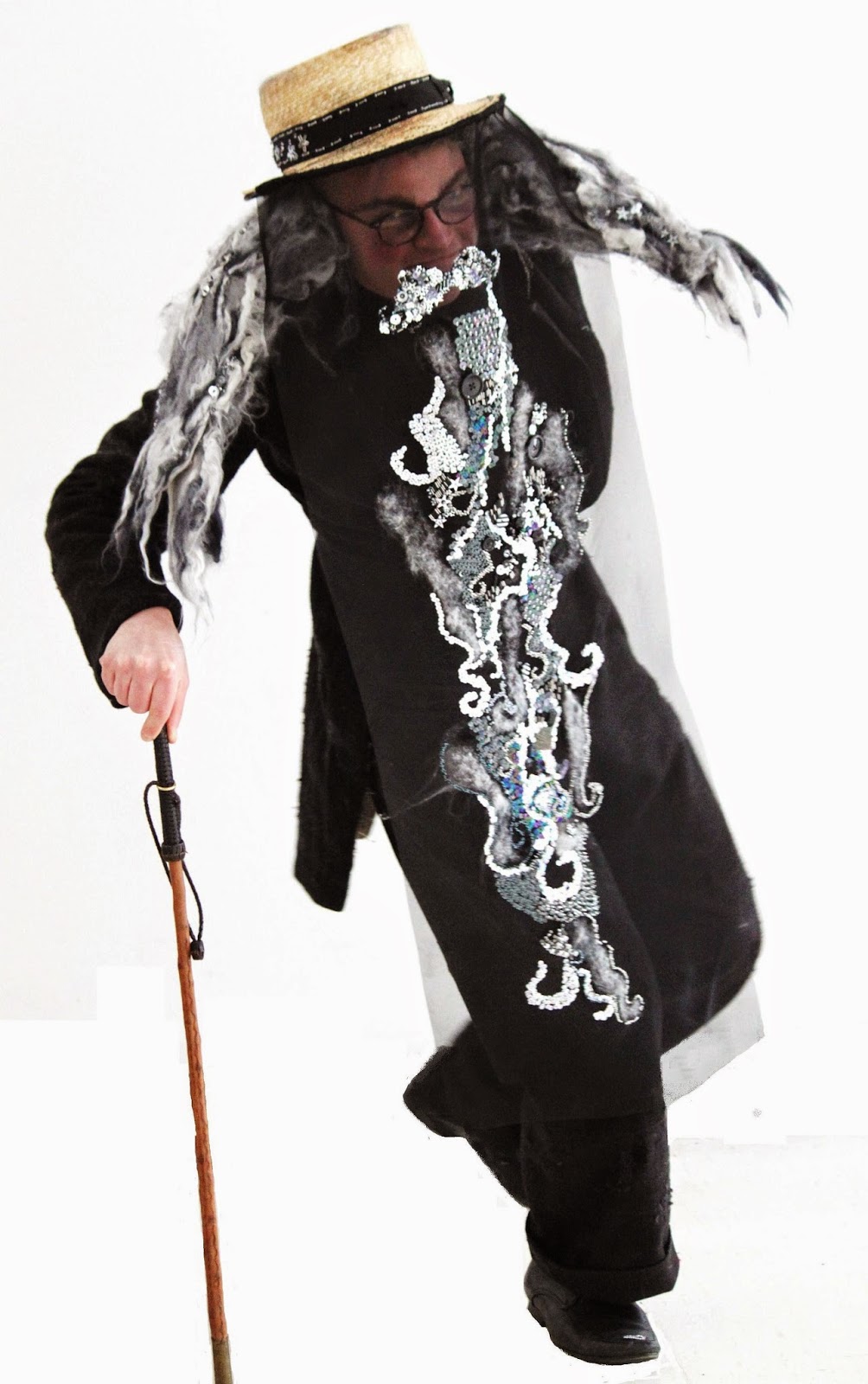
The Maestro (a music teacher) from Angela Carter's Nights at the Circus by Tilly Jones as part of her graduate show for Performance Costume at ECA, with an incredible shimmering sequined beard.
“Hair down to his bum and mixed in with the beard that reached his navel” A sad tale of deception and sorrow, a young man moves to Siberia having been promised his own music school having been given. 
Upon arrival a ramshackle hut and a very small selection of potential students meet him. A cruel sentence for a talented man, unfortunately he rots away for decades until a cast of dysfunctional circus acts bombards his small world. By this time he is wizened and disheveled with his only prize possession being his grand piano but even that is out of tune.  
I have chosen to depict his aging with a veil embellished with a full beard. This also represents his detachment from society as his face is blurred almost out of anonymity." Tilly Jones 


Friday, 15 May 2015

Rachael Eustace

                             Above: photograph by Gareth Easton

"My collection was based on a non themed approach- where I was more interesting in my own methods of creating and sketch booking as a means of my Inspiration. 
I looked at the marks left on the paper and personal writing, all simple but personal research themes. I also looked at photography, particularly  photographers such as Irving Penn, August sander, Walker Evans etc- I liked the images of working men- old uniforms and classic menswear and the styling in such images. 


Styling became a main aspect of my collection as I like playing with the classics by layering and wearing it in different ways- rather than creative cutting. 
I like wearable pieces that are practical and desirable." Rachael Eustace


Rachael Eustace's graduate collection 'The Blind Spot' for ECA AW 2016/17 is a collection of thrift, thread. Showing a reverence for the texture and patina on clothes that have had the life of a much loved second skin, loved, worn, damaged and mended.

Thursday, 14 May 2015

Eleanor Paulin


Graduate collection, 'Genetic Metamorphosis' SS2016 by Eleanor Paulin is a collection that is shredded, layered and gauzy in a wonderful bright palette. The shredded elements made me think of DNA of that scientific need to pull things apart so you can puzzle them back together to gain a fuller understanding.I liked the quirky hand themed accessories and the finger fringed blouses.

"My collection is like a tapestry. It is made up of strands of fabric  that  are  joined together to make a whole.  Much like how I see diversity, in order to create a whole we need to have an all inclusive fashion industry, every ethnicity, age, shape and size should be included and embraced." Eleanor Paulin