Showing posts with label Duncan of Jordanstone College of Art and Design. Show all posts

Wednesday, 29 May 2024

Caitlyn Ross


"This project explores the incorporation of waste through different design methods by utilising yarn waste and dead stock,  preventing it from going to landfill. These materials are broken down through slow making methods on an individual scale to influence the idea of slowing down and promoting the outlook to salvage and appreciate waste.

Through techniques such as needle felting, trapping and plating with the scrap material, the waste has been used in accompaniment with a limited selection of natural based yarns which have had little processing as possible. This will reduce the environmental impact as the only yarns that are outsourced are all biodegradable and have gone through limited additional treatment.

The project aims to promote longevity in design and consumer habits by making people more aware of their waste and recognising what can be done to extend the life of materials."

          Caitlyn Ross


Tuesday, 28 May 2024

Heather Russell


I like to showcase graduates from the Scottish Degree shows. Today it is Heather Russell and her performance piece called 'Your Majesty'. Often I see peoples works at the degree shows and see that they have evolved during their courses and should possibly have been on a different course, fine artists who maybe would have thrived more in furniture or ceramics, textile artists who maybe should have been in illustration. I wonder what Heather would have made on the ECA performance costume course and how her work will go on to evolve in future.


Sunday, 26 May 2024

Mairi Noonan


Language preservation through textiles was a theme of yesterday, as I met a PHD student in Dundee who was researching Inca language woven into their textiles. 

Mairi Noonan's graduate collection explores language and identity preservation through textiles.

Chan eil a -màireach air a ghealltainn – Tomorrow is not promised

"Chan eil a -màireach air a ghealltainn”, highlights the decline in the use of Scottish Gaelic from the early 19th Century to today. Punk ideology runs throughout the concept featuring anti-establishment ideas, the importance of cultural identity and the inherently political nature of how Scottish Gaelic has been repressed. This is reflected in my design choices using words and phrases integrated into the textiles to create a wearable manifesto. The gradual loss of Scottish Gaelic, and associated sadness is captured in John MacLean’s poem “A’ Choille Ghruamach”, featured throughout the knit designs. MacLean expresses his personal dismay surrounding the decline in his use of Gaelic. Though written in the 1820s, much of the same sentiments are reflected in the modern day decline in Gaelic.

Storytelling of Gaelic history through song, poetry and music allows it to be understood on a more personal level. Spectrograms from an archive recording of the poem being sung are used as imagery, connecting to the importance of archives in preserving Gaelic history. The spectrogram also demonstrates the disintegration of the language over centuries through the graduating pixels, alongside the layering of text." Mairi Noonan. 

Sunday, 29 May 2022

Sandra Junele


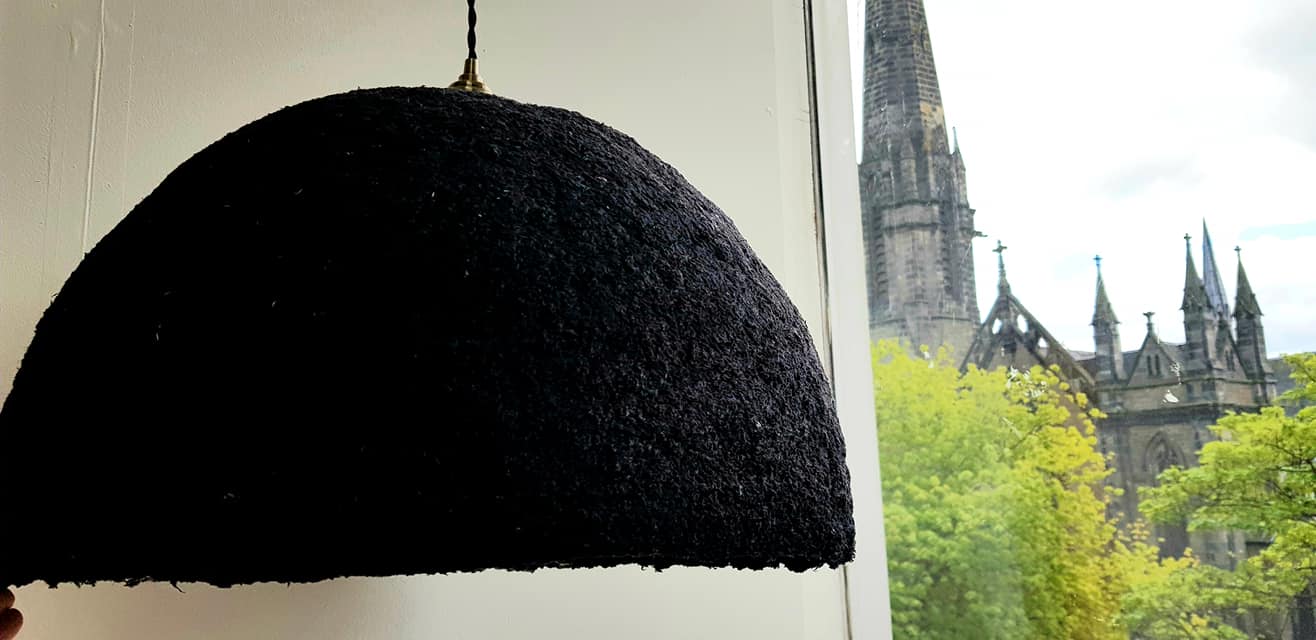
Sandra Junele has been working with waste thread and wool from the studio floor, re designating it as an exciting raw material to create fabrics that can be used for product design making decorative wall panels,  tough surfaces and lamp shades. 

"When should a material be classified as waste? As a future focused designer, I am dedicated to developing sustainable practices. It is crucial that we take responsibility for the lifecycle of the things we design and make. The key process I developed involved mixing the shredded yarn with glue which could then be formed and moulded into various shapes. As circularity is a fundamental part of this project, I used an organic homemade glue. This allows the final material to be broken back down, by placing it in water, and reused potentially endless times. The material is lightweight, dries firm and has many possible applications. Driven by a strong interest in interior design I have used the material to create bold wall panels exploring colour and form and celebrating the natural surface texture created by the yarn fibres. Further embellishment has been added with a range of sewing and mixed media techniques embedded within or added to the surface." Sandra Junele


Wednesday, 6 June 2018

Megan Brown


Wonderful extruded, knitted textiles by Megan Brown some almost translucent, and many very organic and temptingly tactile.


"I have created a collection of knitted samples that inspire a playful interior environment for kids. This collection is heavily influenced by the concept of sensory play and the developmental benefits it has for young children. The visual research that has informed this project is an amalgamation of interesting textures, compositions and colours that were gathered during a walk outside in a play park. These images have helped to inspire bold constructed textiles that are visually and physically stimulating. Through experimenting with both natural and synthetic materials, I have created unusual knitted textures and 3D forms. In addition to this, research into the different types and methods of play has been conducted and considered in my design work. This has been reflected through the use of zips, pull ties and 3D objects- considering how a child could interact with and manipulate samples. The ultimate aim being, to use interactive design as a tool to create dynamic, playful environments that capture a child’s curiosity to explore, play and learn. " Megan Brown 

Thursday, 24 May 2018

Rhia Cook


This week is DCA degree show and I stole away on Monday to see what wonders had emerged in this year's graduate portfolios. I always love the work of the textiles department, imparticular their sketchbook and development work is fantastic to see. Rhia Cook's work really caught my eye and made me smile as she had been working with figures from British politics, Jeremy Corbyn and Nicola Sturgeon.


Collaging features printing, embroidering and flocking them onto fabric and creating a bespoke knitted waistcoat for the cyclist, Mr Corbyn.


"Young people have a reputation for not being engaged in politics. Consistently low voter turnout in 18-24-year-olds has led to many politicians not focusing on appealing to this audience. This has lead to young people’s voices being underrepresented in parliament. To tackle this, I have created a range of textile objects that aim to get more young people in universities to talk about politics and, in turn, have their opinions heard by politicians. By making funny textiles and using them as a facilitator in a workshop style setting, the issues that are important to young people are raised and documented. The hope is that the views gathered, when broadcast, will spark real change and encourage more young people to talk about politics. The collection is heavily influenced by political satire, with its focus being gently mocking Jeremy Corbyn and Nicola Sturgeon, two politicians who are already making headway in engaging young voters. Visually, inspiration has been taken from the oddness of Dadaism and the politician’s personalities to create a gentle, mossy Corbyn and bold, nationalistic Sturgeon. Together, the combination of humour and soft 3D textiles provides an almost child-like, non-threatening way to introduce the idea of politics into conversations, changing the tone from serious to silly to engage more young people. The objects I’ve created may make you laugh, but they also make having the often-awkward conversation of politics just that little bit easier." Rhia Cook


Wednesday, 7 June 2017

Monica Dritschel


Monica Dritschel has engineered bread into a dress, fashioning a complete and complex garment with incredible attention to detail and texture.

"The aim of my work is to skew the role of food. I transform its function from an essential substance ingested to sustain life into an object which envelopes the body. A fundamental food staple is a bread. It has symbolic significance in religion and literature; it engages our visual, tactile and olfactory senses. I use ordinary white sliced bread to create a garment, thereby communicating the complex issues surround the effect of food on one’s body. By, transforming an everyday staple into a fur-like coat disrupts one’s common preconceptions of what one commonly consumes. To warp the function of food. Instead of being viewed essential for life food now becomes a material which envelopes the body. Bread is used to create a garment that establishes a new relationship between the internal and external self. Perceiving dough as a 'clay' expands the boundaries between cooking and contemporary art. The manipulation of this material into a fur-like surface causes disruption of common preconceptions, making one deeply reflect on the role of this common staple." Monica Dritschel

Tuesday, 6 June 2017

Freya Whitaker


"I encourage you to look at our world differently, I ask you to ask if there is a possibility that there is another world, an alternative to this one. I ask you to ask yourself: 'Have these situations already played out?' I ask you to see what I see, to look at the world through someone else's eyes, to listen with someone else's ears. What if this world is just as disorderly as our own but in a new direction? Through my practice, I ask the viewer to eliminate overthinking and complexity to access your inner imagination that may long be forgotten."  Freya Whitaker 
A giant mask with fractual lenses was part of Freya Whitaker's degree show encouraging you to step inside and see the world from a different point of view.

Thursday, 16 June 2016

Fern Slater-Walters


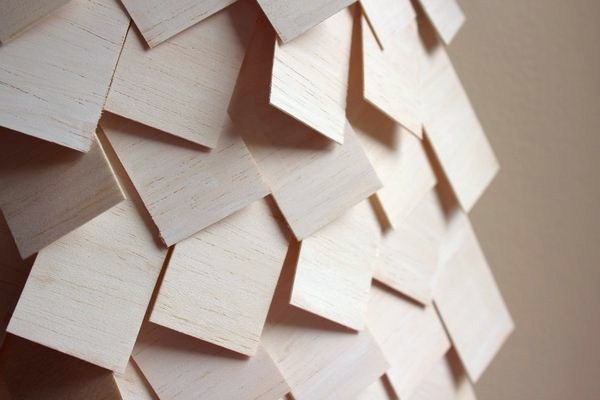
Fern Slater-Walters has just graduated in textile design from DCA, her intricate sculptural textural designs were akin to origami and created fascinating tactile surfaces.
"The Great Divider project is a range of textile installations designed to enhance the work environment. The project is separated into two different collections. The first range includes handmade felt, to white washed balsa wood. Each individual design is made with texture and light in mind. All pieces let through light and in doing so bring a whole new dimension to not only themselves but the office space. The second collection is a set of wall tiles made from ink dyed balsa wood which have been sanded back and varnished, to create an inspiring display. All of these designs have been made to bring creativity and productivity into the office environment." Fern Slater-Walters


Tuesday, 31 May 2016

Shiona McMahon


"This is a process driven project analysing how natural dying techniques, such as: rust, fruits, seeds and plants, react differently to a variety of fabrics. I experimented by pushing the boundaries of these techniques while learning to control and replicate shape and pattern. The fabrics I have chosen to use all have their own individual qualities. By using different materials this demonstrates how diverse the techniques change depending on the medium. My collection will aim to show how versatile the processes can be and how they react towards different fabrics. These fabric panels are all natural and are designed to be used as insulation's for commercial interiors market." Shiona McMahon

Friday, 27 May 2016

Morag Taylor


This is the work of Textile design graduate Morag Taylor you can catch her work as part of the Duncan and Jordanstone College of Art Degree Show at Dundee until Friday the 29th May. 


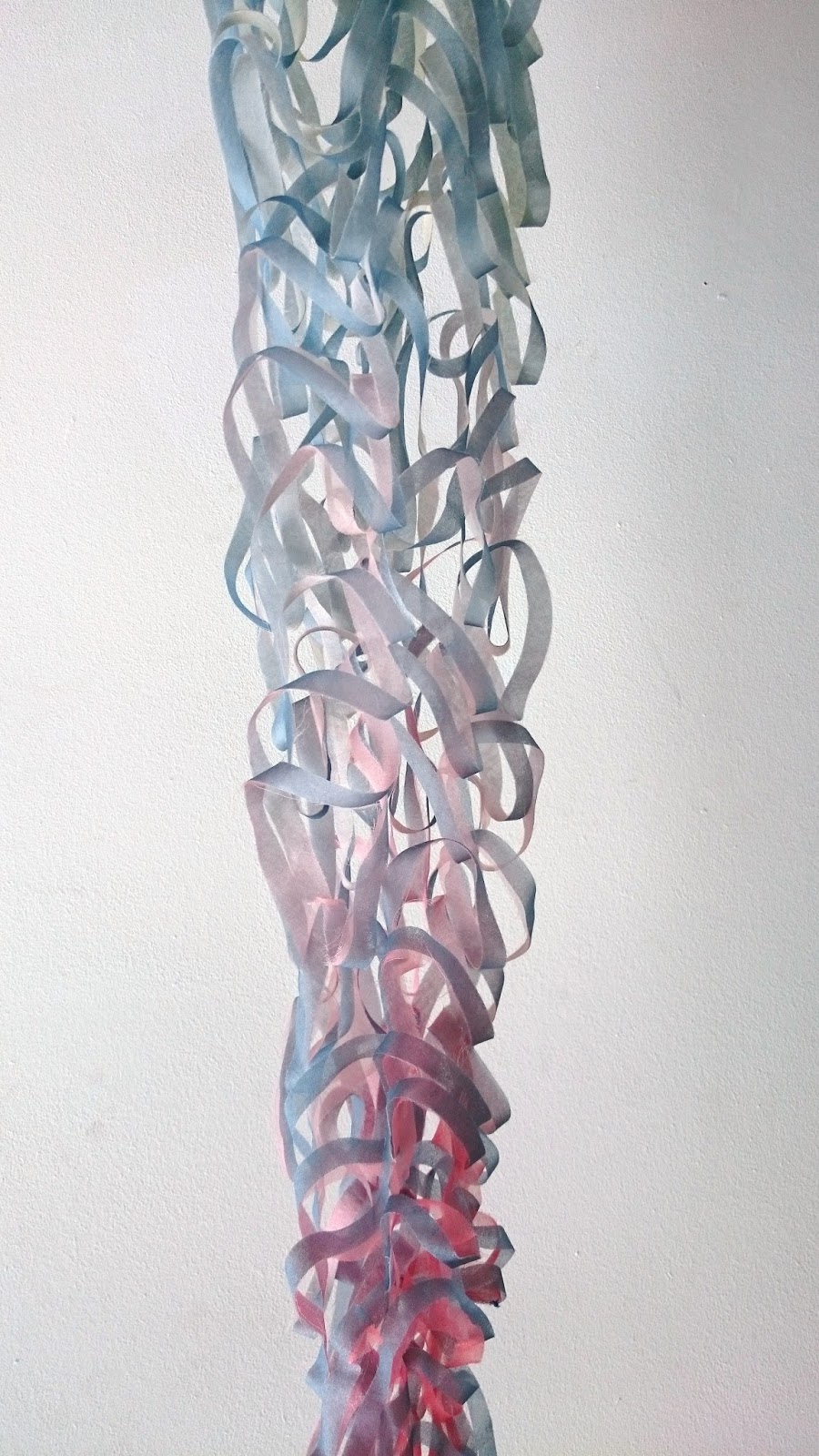
"I have been exploring form, movement and colour and how they relate to each other through manipulating materials in different ways. Form. Discovering how the form that the fabric takes can be altered through cutting and layering techniques. Movement. The forms come to life through the way that they are held and stretched evolving from flat two-dimensional pieces into new structures. Colour. Inspired by the surface and reflections on water, dying fabric in subtle gradients and solid colours plays an important role in transforming the pieces. The fabrics are layered to have different colours on each side so that when moved the three-dimensional aspect is emphasised. I have made a collection of fabric samples to be developed into wearable pieces." Morag Taylor
Morag Taylor has been exploring slashed fabrics creating form from sheets of fabric through repeated cuts contorting the fabric into a honeycomb or lace-like form. Her work has been inspired by the undulation of water and light refracted on its surface.