Sunday, 17 May 2015

Gwendolyn Basala


Gwendolyn Basala's poetic interpretation of the girl Without Hands for her graduate collection in Performance Costume at ECA.
"Adapted from the original 1812 publication by the Brothers Grimm, my version of The Girl Without Hands takes place in an alternate early 19th century Germany. There, a poor miller's daughter might some day marry a queen, and love is as powerful as any supernatural forces inhabiting the land.Drawing heavily on extensive historical research into German Folk Costume vs. high fashion from that era; the designs reflect a level of historical accuracy to match the innocent and prosaic reality at the beginning of the story, and deviate away from that accuracy as the supernatural makes its impact upon the main character, The Girl." Gwendolyn Basala

Saturday, 16 May 2015

Tilly Jones III


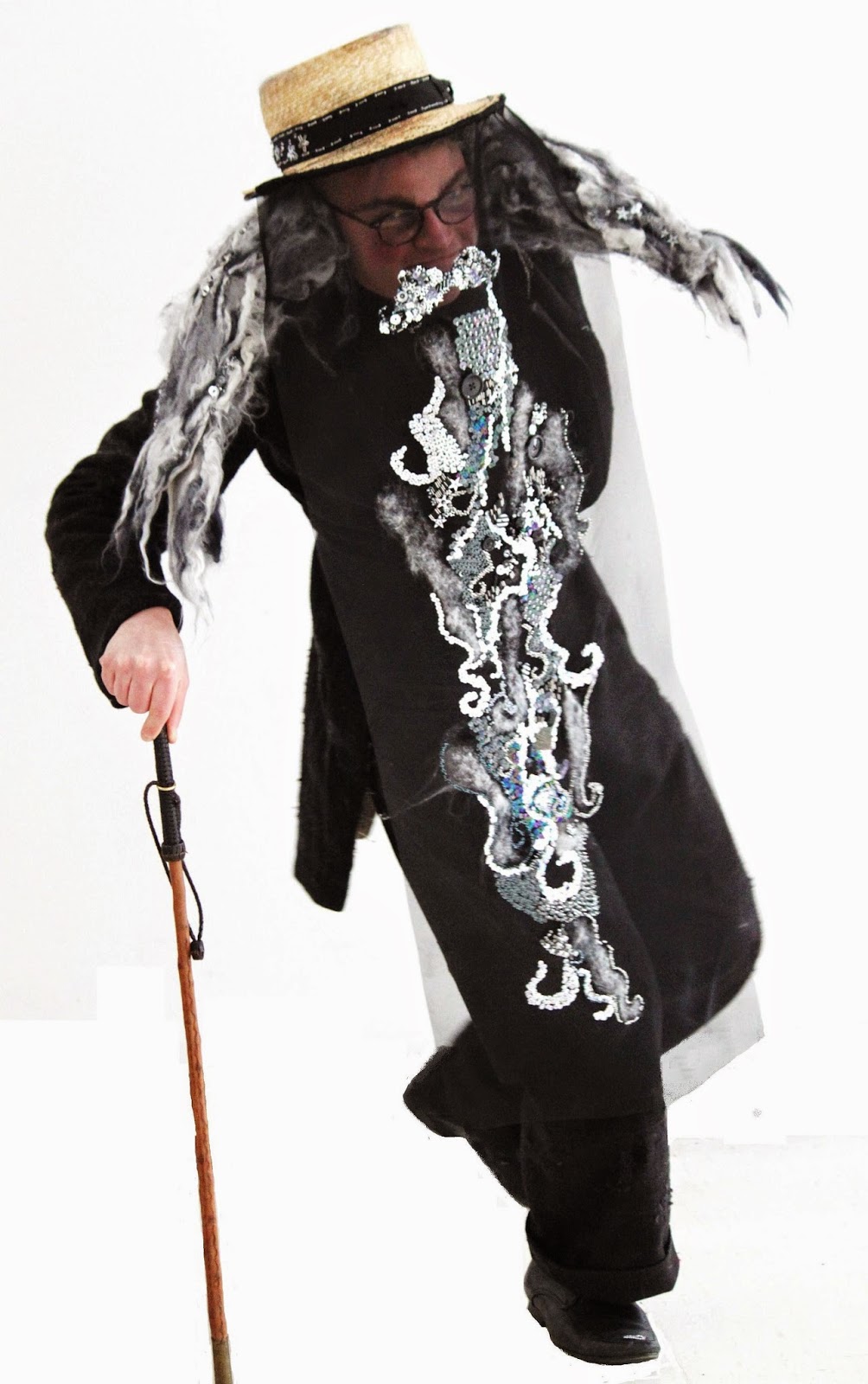
The Maestro (a music teacher) from Angela Carter's Nights at the Circus by Tilly Jones as part of her graduate show for Performance Costume at ECA, with an incredible shimmering sequined beard.
“Hair down to his bum and mixed in with the beard that reached his navel” A sad tale of deception and sorrow, a young man moves to Siberia having been promised his own music school having been given. 
Upon arrival a ramshackle hut and a very small selection of potential students meet him. A cruel sentence for a talented man, unfortunately he rots away for decades until a cast of dysfunctional circus acts bombards his small world. By this time he is wizened and disheveled with his only prize possession being his grand piano but even that is out of tune.  
I have chosen to depict his aging with a veil embellished with a full beard. This also represents his detachment from society as his face is blurred almost out of anonymity." Tilly Jones 


Friday, 15 May 2015

Rachael Eustace

                             Above: photograph by Gareth Easton

"My collection was based on a non themed approach- where I was more interesting in my own methods of creating and sketch booking as a means of my Inspiration. 
I looked at the marks left on the paper and personal writing, all simple but personal research themes. I also looked at photography, particularly  photographers such as Irving Penn, August sander, Walker Evans etc- I liked the images of working men- old uniforms and classic menswear and the styling in such images. 


Styling became a main aspect of my collection as I like playing with the classics by layering and wearing it in different ways- rather than creative cutting. 
I like wearable pieces that are practical and desirable." Rachael Eustace


Rachael Eustace's graduate collection 'The Blind Spot' for ECA AW 2016/17 is a collection of thrift, thread. Showing a reverence for the texture and patina on clothes that have had the life of a much loved second skin, loved, worn, damaged and mended.

Thursday, 14 May 2015

Eleanor Paulin


Graduate collection, 'Genetic Metamorphosis' SS2016 by Eleanor Paulin is a collection that is shredded, layered and gauzy in a wonderful bright palette. The shredded elements made me think of DNA of that scientific need to pull things apart so you can puzzle them back together to gain a fuller understanding.I liked the quirky hand themed accessories and the finger fringed blouses.

"My collection is like a tapestry. It is made up of strands of fabric  that  are  joined together to make a whole.  Much like how I see diversity, in order to create a whole we need to have an all inclusive fashion industry, every ethnicity, age, shape and size should be included and embraced." Eleanor Paulin

Wednesday, 13 May 2015

Holly Prescott


Holly Prescott is a final year performance Costume student at ECA. These are her lavish interpretations of Grimm's fairytale, 'The Golden Bird'.
"Bursting with rich imagery The Golden Bird is one of the lesser known fairytales from the Grimm’s vast repertoire. Having not been adapted into a screenplay previously, free and personal interpretation of the characters and settings could take place. This research began with the exploration of other Grimm’s fairytales including illustrations by artists working in the early 1900’s such as Harry Clarke and Kay Nielson. The intricacy of pattern within these scenes, which still held an eerie quality often associated with the Grimm’s style of writing, influenced my thoughts and I decided to start exploring the elongated silhouettes and styles of dress similar to those depicted in the artwork using this era of the early 20th century as a starting point for visual referencing.


As the process continued further links between the traditional fairytale and this era emerged, such as the lack of scripted dialogue between characters within the story strongly coinciding with the popularity of silent film in the early part of the 20th century. Interested in the ways that a story can be understood without the use of vocabulary suggested to me that I should attempt to set an adaptation combining strong influences from the early 1920s with contemporary fashion influences. The issue of prohibition and the yearning for luxury in this period highlighted further links to the original fairytale and provided the basis for an adaptation for contemporary film.

I continued research into the opulent and extravagant society of the 1920’s, given the nickname ‘The Golden Era of Hollywood’, and expanded on this lavish aesthetic, exploring the silhouettes of film portraiture and haute couture and relating textile techniques,including embellishment and bias cutting, back to this era juxtaposed with contemporary techniques for a modern retelling. I aimed to create a response to these silent films that included subtle shapes that spoke for themselves, taking inspiration from iconic ‘national treasures’ such as film stars including Rudolph Valentino and Gloria Swanson.
Around 70% of all silent films ever produced have now been either lost or destroyed. I found this fact distressing, wondering how the foundations of modern cinema could have fallen into such disregard. With this in mind, I aim to pay homage to these cinematic treasures by creating costumes for the three gilded treasures that reflect elegance and delicacy with a touch of precious deterioration as a reference to both the decay of the silent film industry and the rotten society at the time which is similarly described in the fairytale." Holly Prescott

Tuesday, 12 May 2015

Georgia Adele Noble I


The fashion show at ECA is an opportunity to glimpse some of the talent coming up through the college in Fashion and Performance Costume as well as the emerging graduates.
This is the work of third year Performance Costume student Georgia Noble for 'Orlando' the screen play.
"I focused on the time period 1910, which to me evoked feelings of change and freedom within society and  fashion of the time. Corsets were no longer across the chest and sat on the hips but instead they would sit neatly under the bust and skim across the buttocks to give an elongated shape for the sheer and loose fabrics the women wore. Evening dress was elaborate and coats were edged with luxurious fur, hats were decorated with feathers and jewels and the women wore long draped dresses on the under layer. I was inspired by the popular 'opera jackets' of the time and decided to make my own Paisley print through disperse dye which was then had embellished with sequins as a feature on the back. The hat was made with felt as a base layer then draped with velvet to replicate the expensive styles of the time. The model I had chosen had a popular body shape from the time long limbs, an exaggerated and small torso and the complete the look exaggerated eyes and hair styling. I used the traditional 1910 style with a twist on modern fabric creation but kept the luxurious feel." Georgia Noble 

Monday, 11 May 2015

Mélissa Villevieille


It is not often that models walking off from the catwalk cause a stir, but they did when wearing Melissa Villevielle's collection Fauve Moi? at the ECA fashion show. The concentric 'target' pattern on the bottoms grabbed an audible gasp from the audience.
It is good when a designer shifts the focus and gives attention to the whole figure in their designs, Melissa's collection was bold graphic stripes in contrasting flowing and structured garments.